

The Matrix Called the Chinese Robot Ban 23 Years Ago
The FCC banned Chinese robots while every American robot still runs on Chinese parts.
There’s a scene in The Matrix Reloaded that I’ve been thinking about for more than twenty years. Councillor Hamann can’t sleep, so he takes Neo down to the engineering level of Zion in the middle of the night. Above them, the machines are drilling toward the last human city, days away from killing everyone in it. Around them, other machines hum away, cleaning the water and recycling the air.
Hamann tells Neo he likes walking the engineering level because "this city survives because of these machines. These machines are keeping us alive, while other machines are coming to kill us." Neo objects that the machines are under human control, and that the humans could shut them down if they wanted to. Hamann agrees. "If we wanted, we could smash them to bits. Although if we did, we'd have to consider what would happen to our lights, our heat, our air."
I was in college when I first watched that scene, and it has aged better than almost anything else in that movie. You only control a machine you can turn off and survive, and everything else controls you a little, no matter whose hand is on the switch.
The United States had its Hamann moment two weeks ago.
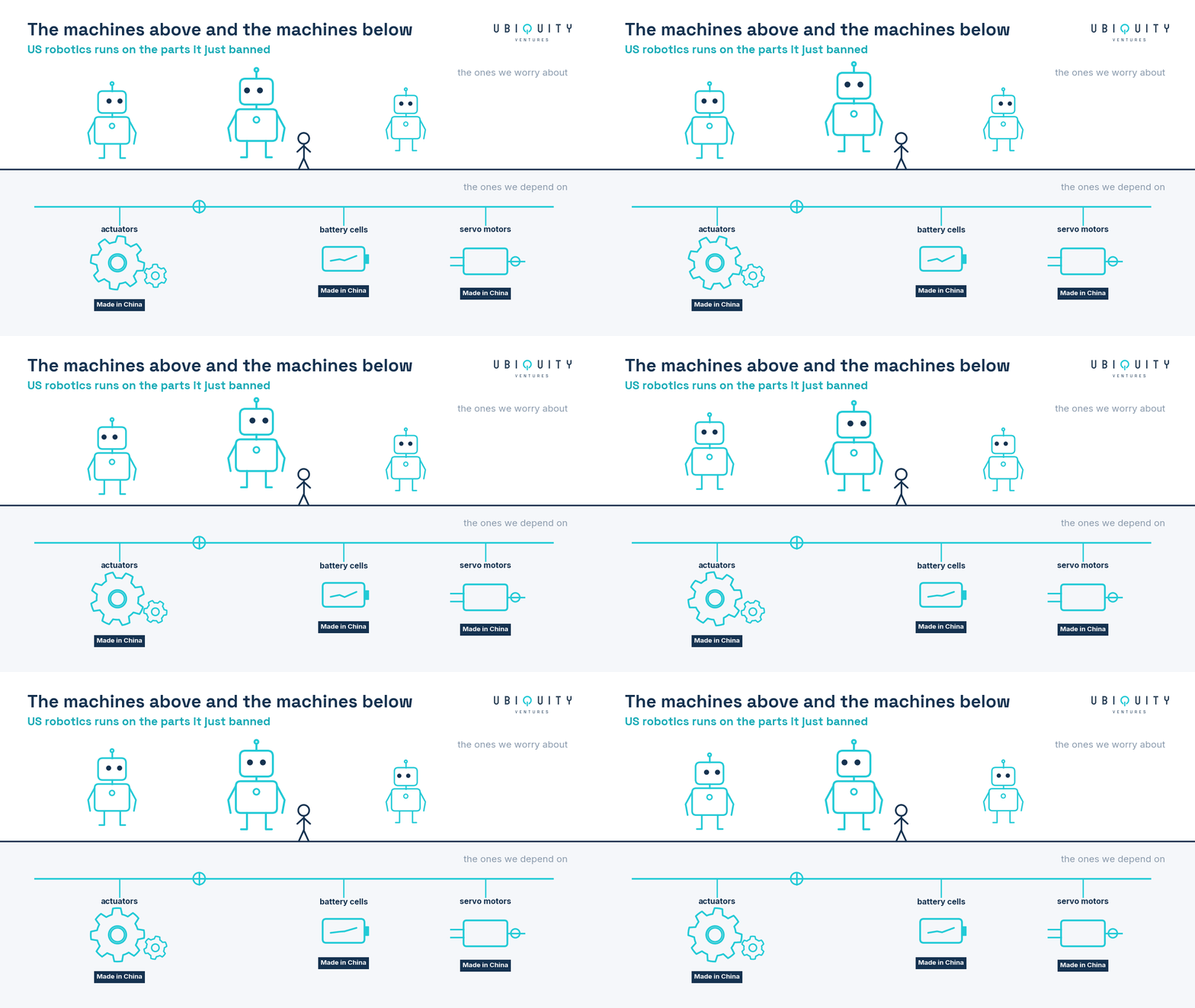
The machines above
On July 28th, the FCC banned new Chinese-made humanoids, quadrupeds, and connected power inverters by adding “advanced robotic devices” to its Covered List. The move followed a vulnerability discovered earlier this year in which a line of foreign home robots exposed live camera feeds, microphone audio, and floor plans from thousands of devices. China holds roughly 85% of the humanoid market. The rule is also written broadly enough that future Roombas, lawn mowers, and delivery bots get swept in.
If you only look up, this is a tidy story. The scary machines are foreign, they walk and see and listen, and now they’re banned. Problem solved!
The machines below
Then everyone who actually builds robots looked down.
Ted Xiao, a founding technical staff member at Prometheus AI, put it bluntly on X: “Every single live player in robotics + AI relies on Chinese hardware; the US robotics hardware ecosystem is years behind.”
Open up a humanoid and the joints are high-torque actuators built around rare-earth permanent magnets. China processes roughly 90% of the world's rare earths and produces over 90% of those magnets, so when it restricted heavy rare-earth exports in 2025, magnet constraints slowed production of Tesla's Optimus, which is about as American as a humanoid gets. Battery cells and precision motors run through the same handful of Chinese suppliers. Even the parts that aren't Chinese mostly aren't American, since the harmonic reducers in most robot joints come from Japan.
This is Zion’s engineering level. The machines below are the anonymous parts inside every American robot, and nobody in Washington counted them before reaching for the off switch. We regulated the science fiction version of robotics, the one with the scary walking machines, and missed the version that actually exists, which is a bill of materials.
Control is what you can turn off and survive
Apply Hamann’s test to the recent ban: could the US go a week without Chinese robotics? Losing the finished robots would sting a little and change nothing, but the components inside them sit in every American robot too. The ban aimed at the machines above without noticing that our machines below run on the same parts.
The ban itself is defensible. A country probably shouldn’t fill its homes with networked cameras on legs built by a strategic rival. What bothers me is the sequencing.
You don’t declare independence from the attic while your basement runs on their parts. Build the magnet processing, the actuators, the cells, and the motors, and then you can afford to say no to the finished machines. Ban first and build later means a multi-year stretch where American robotics is both cut off and years behind, which is the worst square on the board.
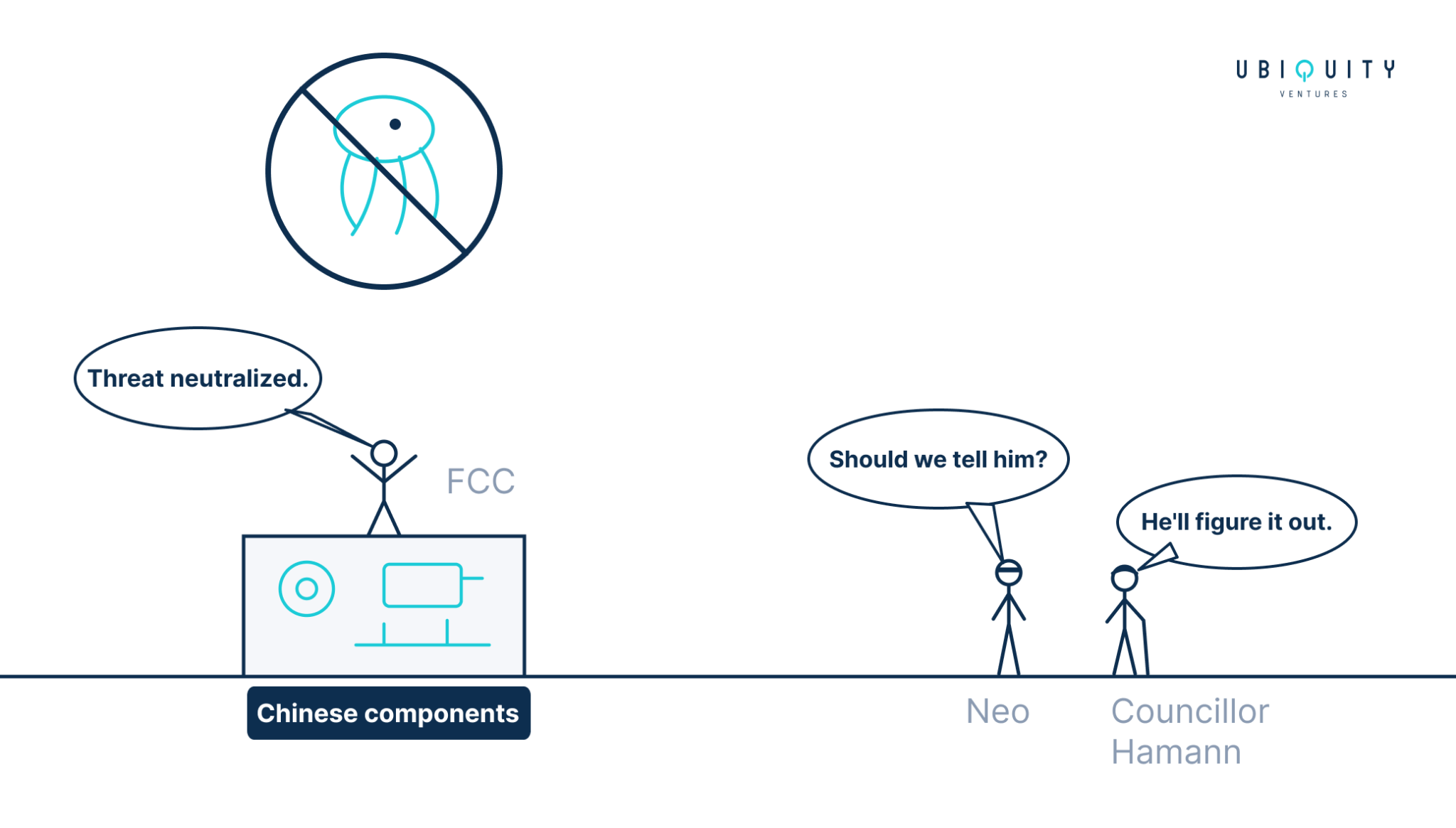
The good news is the basement is finally under construction! MP Materials runs the only operating rare earth mine in America and is scaling domestic magnet capacity with Defense Department backing. Another domestic supplier, USA Rare Earth, started producing magnets at its Oklahoma plant this spring and has the richest heavy rare earth deposit in the country waiting in Texas. Niron Magnetics makes magnets with no rare earths in them at all and recently broke ground on its first plant in Minnesota.
Why a seed investor cares
At Ubiquity Ventures we back "software beyond the screen," so our founders build things that live in the physical world, and every one of them sits downstream of this supply chain. Halter's collars steer cattle across New Zealand hillsides on batteries, GPS chips, and solar cells. Queue's pharmacy robots are full of small motors. Even WindBorne's weather balloons, about as far from a humanoid robot as hardware gets, carry sensor boards from the same parts bin.
Founders building hardware should know where every motor, magnet, and battery cell in the product actually comes from, not just the vendor but the vendor's vendor. Under the new rule, even a robot assembled in America counts as foreign unless US-made components make up at least 65% of its value. Have a backup plan for your bill of materials. And if you're a technical founder staring at that dependency list wondering whether magnet processing is a venture-scale business, the US government just made your market for you.
Neo ends that scene with a line I like more as I get older. “So we need machines and they need us.” In our case it mostly runs one way, since we need China’s magnets a lot more than China needs anything robotic from us. Every magnet plant that breaks ground here moves us a little closer to the version Neo was describing.
Thank you for highlighting this issue.
The FCC ban is a sledgehammer non-fix to a significantly challenging technical issue - connected devices are designed to leak (broadcast) data.
The FCC ban fails to address the challenges that exist from complete products all the way through the component supply chain to BLE/WIFI modules, 5G/LTE modems, and China-developed SW BSP packages.
EU and other countries have been working to address these issues with data privacy and connected device security regulations for the past couple of years.
Fundamentally, the depth of these challenges is difficult for most tech companies to understand and even more difficult to address.
This is a great framing, Sunil. “You only control a machine you can turn off and survive” is the line that sticks.
I’d extend it one layer further as robots become increasingly autonomous. Control won’t just be about who made the magnets, actuators or batteries. It’ll also be about whether we can independently verify who authorized the machine, what it’s allowed to do, and whether that authority can be revoked without depending on whoever built or operates it.
The trust boundary isn’t the chassis. It’s the entire dependency graph, hardware, software and authority.
Ps: I really loved that scene from The Matrix --also saw it for the first time in college.