

The Single Biggest One-Day Gain in Stock Market History Went to AI Restraint
Prior stock market records were set by leaning into the AI capex race. This one was set by Microsoft stepping back from it.
Last Thursday, Microsoft’s market cap grew $450 billion in a single day. That is the largest one-day gain any company has ever posted, topping Nvidia’s previous $440 billion record. The gain alone is worth more than 96% of the companies in the S&P 500.
Here’s the part that makes this a first. Every prior record was set by leaning into the AI capex race. This one was set by stepping back from it. Microsoft CFO Amy Hood told investors the company expects to keep spending stable and remain cash flow positive next year. The market responded positively and added half a trillion dollars to Microsoft’s value.
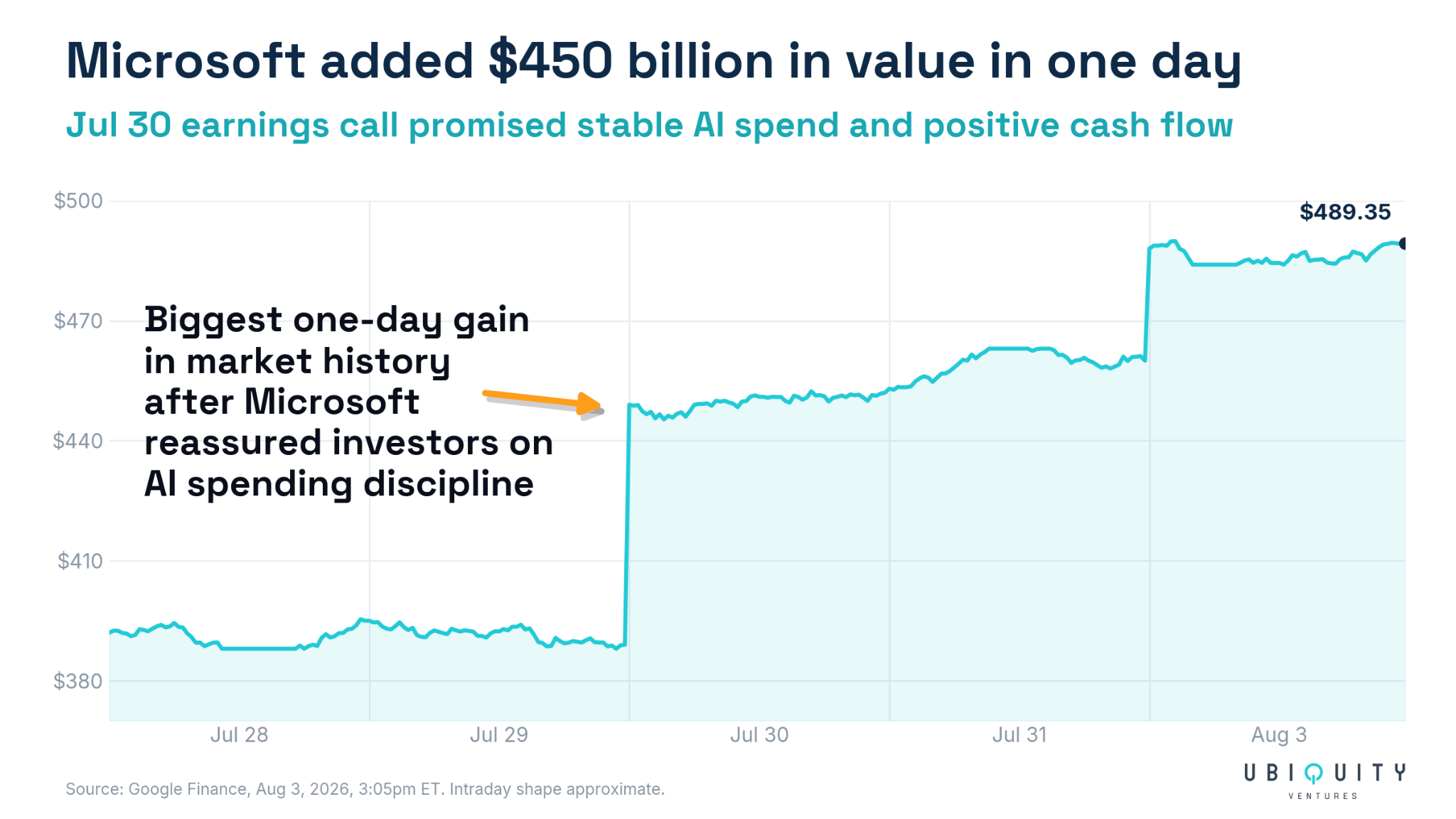
For the past three years, Wall Street has treated data center capex as a proxy for AI seriousness. Announce another $100 billion of GPUs and your stock goes up, because spending big reads as playing to win. The problem is what that money actually buys: fixed hardware on depreciation schedules that assume five or six years of useful life, in a field where chips are outclassed in two. Much of today’s capex will be obsolete before it’s paid off.
The cash flows now make that visible. Google and Amazon have both tipped into negative free cash flow. Meta is expected to follow, having has signaled plans to spend nearly $700B over coming years. Microsoft is the lone big tech company saying its free cash flow remains positive despite AI investment, and it was the one rewarded with the largest single-day gain in market history.
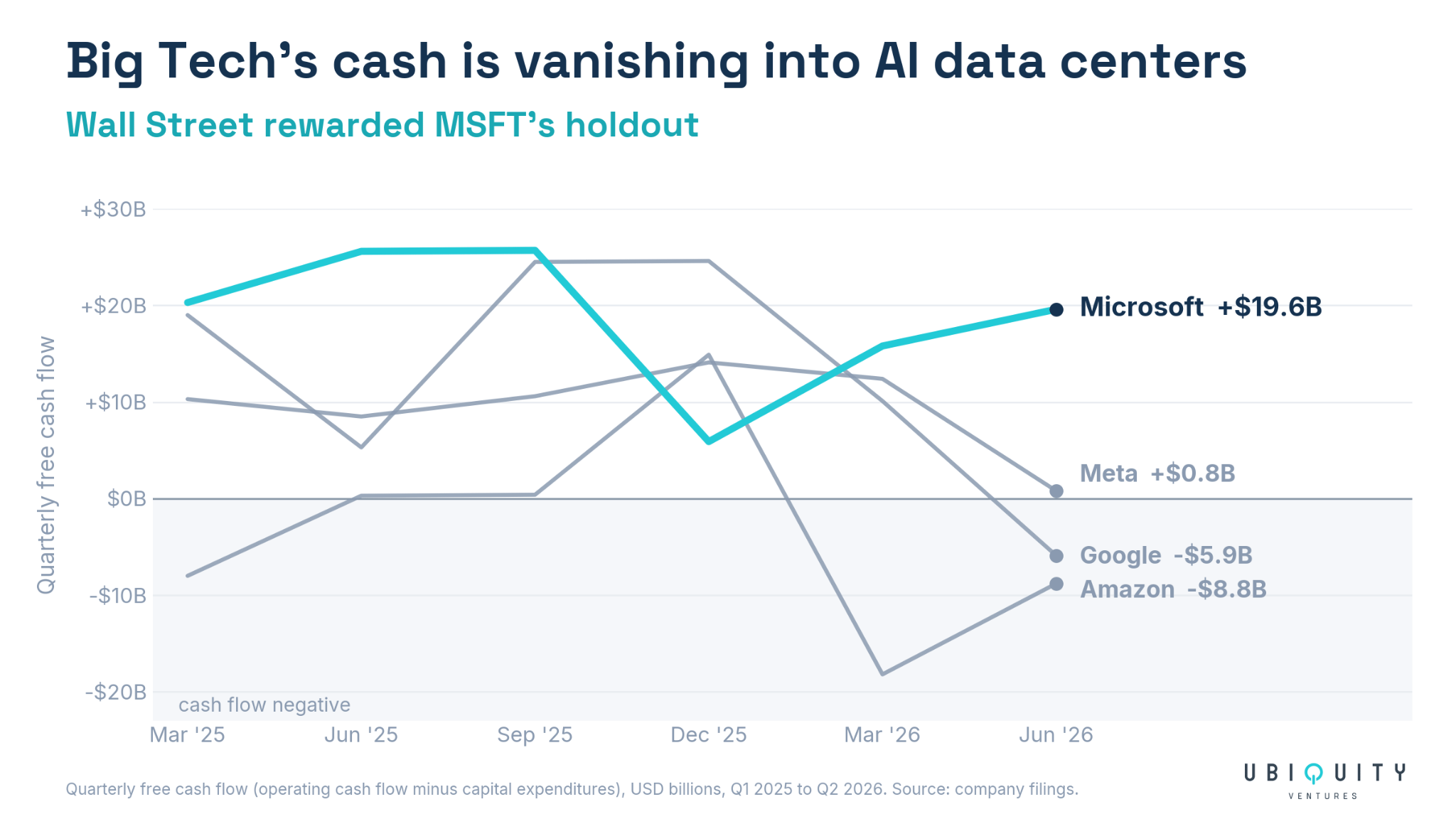
To be fair, restraint has burned Microsoft before. The company pulled back on data centers in early 2025 and spent the next year regretting the capacity shortage. Amazon’s Andy Jassy argues today’s spend is the AWS build-out all over again. Maybe. But when the biggest one-day gain ever goes to the company preaching discipline, the market is telling you what it now believes.
Where we put our money
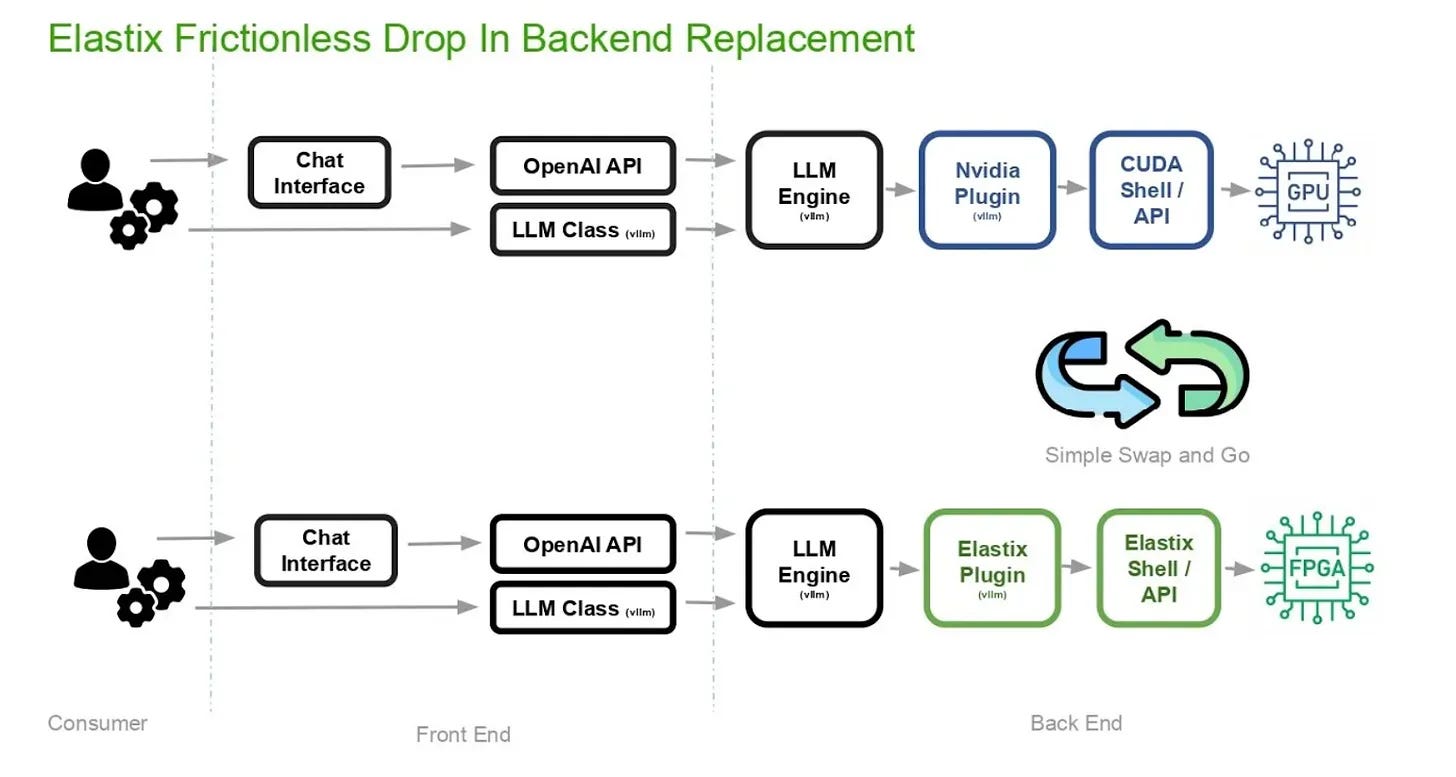
This is why we invested in ElastixAI last year. The depreciation gap above is a hardware problem, and ElastixAI builds the hardware answer. Where a GPU is fixed the day it leaves the fab, Elastix runs models on FPGAs, chips that can be reconfigured in the field without changing the underlying chip. Their system effectively compiles each model into hardware, so when a new architecture or optimization drops, the same silicon is reprogrammed to run it instead of heading for the scrap heap.
Switching doesn’t mean rewriting your stack, either. Elastix plugs into the same serving layer teams already run, so the swap from GPU to FPGA happens behind the API:
The economics are the point. Inference, actually serving models to users, has become AI’s dominant cost, and today’s fleets fight it with hardware that leaves much of its capability idle. Elastix is already running LLMs in the hundreds of billions of parameters on off-the-shelf FPGAs, with the potential for 50x to 100x cost efficiency gains as models keep evolving. This team has lived at this exact intersection before: they built Xnor.ai, the quantization pioneer acquired by Apple, then worked on Apple Intelligence and LLaMA-class models inside Apple and Meta.
As we wrote when we announced the Elastix investment, AI is going to be constrained by economics, not intelligence. Buying fixed-function hardware that can’t adapt to run models that change every quarter is how you end up with the charts above. The market just paid Microsoft $450 billion for spending discipline. We think the same logic reaches the silicon.
Nerdy and Early is where Sunil Nagaraj shares candid and sometimes contrarian thoughts on investing, space, life, and other rabbit holes worth exploring.
For Ubiquity Ventures investment announcements and portfolio news, follow along with the Ubiquity Ventures Newsletter.